Going Where the Bluegrass Grows
Going Where the Blue Grass Grows: The Poetics of Sarah Josephine Pennington
Where the Bluegrass Grows, June 1916
Sarah Josephine Pennington
Porkbelly Press, 2025
$9
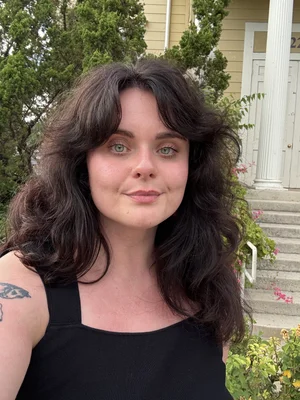
When first engaging with the art that is poetry, usually a mentor or instructor would advise one to pay attention to what is concrete and what is an abstraction. Concrete deals in sweat between fingers, the feathering touch of grass to an ankle, or the scent of your grandpa’s chewing tobacco Coke bottle. The abstract barters in what is intangible; grief, ecstasy, love, what we know so intimately within our bodies but require a material vehicle to express. Sarah Josephine Pennington’s Where the Bluegrass Grows, June 1916 from Porkbelly Press (2025) is but one of many chapbooks that indulge in the specific–from title to line, we encounter a witness who is sensual and attentive to familial bonds, personal history, and the bodies of women who I would reckon still reside in us. Pennington is a queer and disabled writer who utilizes collage and documentary poetics to expose readers to the parallels between her modern-day Kentucky and the one her grandmother knew simultaneously as both obstacle and home.
One cannot help but appreciate the Dickinsonian impulse that arises in Pennington’s work. Throughout the collection, these fantastic em-dashes appear that exacerbate this longing for a place to divulge its secrets to the speaker. However, in the opening poem of the collection “farm fields of kentucky,” it seems to me as though the speaker is place; the fields “where the blue / grass grows” tell the reader that movement is not possible unless they “unite / [their] two wings.” I adore this metaphor; that only a body joined with the land can access some token of insight of truth. It is the enjambment of the line “come nearer—” that resonates so with me.
In a recent class, when I asked students what kind of personality they would ascribe to this playful mark, their responses ranged from passionate to lonely to eager. Pennington’s deployment of the em-dash too functions as a way to make space for the reader such as in poems like “a killing on Stinking Creek” and “mother/child,” poems where newspaper articles serve as catalysts for the poetic exploration and encourage the reader to meditate tenderly before jumping to conclusions. To its list of characteristics, perhaps we too can say that the em-dash is proactive, benevolent, and wonderfully sagacious.
While spending time with Pennington’s poetry, I noticed many concerns arise: that of survival, accessibility, gendered oppression, and the repetition of cycles that are harmful to women. All these topics intersect in the poem “mother/child” which for me, serves as the backbone of the chapbook. It is an exquisite ‘found’ poem that I argue could be read as a contrapuntal due to the incisive stylistic choices made by Pennington. The poem follows the narrative of a mother who, based on limited information from the newspaper, commits infanticide not once but twice in rural Kentucky. I adore that there is this strict indention in the first half of the poem which illustrates a stark separation between mother and child. Such a move reads to me that Pennington is criticizing the relational reality of most women, that when known as mother, sister, wife, or intimate partner, only then do they possess purpose or value.
This issue is not confined to 1916, but a persistent problem that many women encounter now over 110 years later. There is a startling moment of humanity that renders me breathless each time I encounter it: “in jail, she rose bright and early to dress, to comb her hair.” The ‘outcry’ that appears later in the poems calls for the formation of humane societies and the conversion of “heathens,” but Pennington raises an alternative solution: why not “ask about the man / who laid with her?” Why not parse this history a bit more to understand why a young woman could be driven to take the life of her children? Agency is restored when Pennington situates this piece of history not as a tale of a “weak” or “fallen [woman],” but one upon whom blame has wrongly been cast.
It has been a pleasure to spend time with the mind and voice of Sarah Josephine Pennington. She is doing necessary work as an Appalachian writer by troubling received histories and complicating narratives around the lives of women and their pain. One can find more of her work in publications like Salvation South, Still: The Journal, ynst, Untelling, and riddlebird. She is the author of another chapbook through Harvard Square Press titled Cat Lady: A Journey in American Sentences that I am looking forward to acquiring. Pennington is an emerging talent from whom we can expect complex, voice-driven poetry that simultaneously harrows and inspires.